

B2B SEO has a reputation for being boring and predictable. Long-tail keywords, whitepaper landing pages, gated content behind lead forms, and an eternal debate about whether SEO or ABM is the better channel. The stereotypes have enough truth in them to persist, but they obscure what’s actually happening at the sharp end of B2B search competition — which is getting significantly more sophisticated, more data-driven, and more difficult to win without genuine strategic depth.
The businesses winning organic search in competitive B2B markets in 2026 aren’t winning by doing traditional SEO better. They’re winning by operating at a level of complexity that traditional SEO simply can’t match.
The B2B Keyword Problem
B2B keyword landscapes are genuinely complex in ways that consumer markets aren’t. The same underlying product or service gets searched for by buyers at different stages of awareness, with different levels of technical sophistication, using different vocabulary. A procurement manager searching for “vendor management software” has different intent than a CTO searching for “API-based vendor integration platform” and a CFO searching for “reduce vendor management costs.”
These are potentially the same sale. They’re completely different keyword territories that require different content approaches, different depth levels, and different conversion architectures.
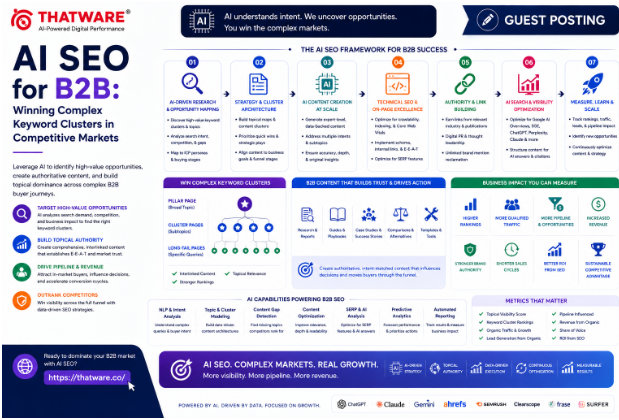
AI SEO framework for B2B maps this complexity systematically. Rather than treating keyword research as producing a flat list of terms ranked by volume, AI-powered analysis builds a multidimensional map of the keyword landscape — organized by buyer persona, intent stage, technical sophistication level, and topic cluster — that makes the structural complexity of the B2B search landscape visible and navigable.
Long Sales Cycles and Content Strategy
B2B purchases typically involve multiple stakeholders, extended evaluation periods, and numerous touchpoints between initial awareness and purchase decision. This creates both a challenge and an opportunity for SEO content strategy.
The challenge: it’s very hard to attribute an SEO-influenced sale to a specific piece of content when six months and fifteen touchpoints separate the first organic click from the closed deal. Analytics attribution models fail spectacularly at capturing this kind of contribution.
The opportunity: a B2B buyer who encounters your educational content repeatedly during their research phase — finding it consistently high-quality, genuinely authoritative, and helpfully structured — forms a brand familiarity and trust that has real commercial value. The content you rank for at the beginning of their journey is doing pre-sale work that your sales team would otherwise have to do.
AI SEO agency strategies for B2B increasingly focus on building topical presence across the full research journey, not just targeting the bottom-of-funnel queries where purchase intent is explicit. The brands that show up throughout the buyer’s research — not just when they’re ready to request a demo — win a different and often more significant kind of attention.
Competitive Intelligence in B2B Markets
B2B competitive SEO dynamics are interesting because they’re often highly concentrated. In most B2B software categories, three to five companies dominate organic search results, and the gap between them and everyone else is substantial. Getting into that conversation requires understanding specifically what those leaders are doing — and more importantly, where they’re not.
ML-powered competitive analysis can map the full topical coverage of category leaders, identifying the specific content gaps where they have high-volume keyword opportunities without strong competing content, where their existing content is aging and ripe for displacement, and where new entrants have built authority in subtopics that the leaders have ignored.
These gaps are real and frequently valuable. Category leaders tend to focus on their strongest keyword clusters and underinvest in adjacent topics — often the exact informational territory where later-stage buyers do their deepest research.
Account-Based SEO: Meeting High-Value Targets in Search
One of the more interesting applications of AI-powered B2B SEO is what some practitioners call account-based SEO — using data about your target accounts to identify what specific companies in your ICP are searching for, then creating content that addresses those specific use cases and pain points.
This isn’t surveillance — it’s publicly available search data used intelligently. When your ideal customer profile companies are consistently showing up in organic searches for specific problem statements or competitor comparisons, that’s actionable signal about what content would attract them. It bridges the gap between ABM targeting precision and SEO’s scalability — and it’s essentially impossible to do without AI-level analysis of search data.
The B2B organizations that invest in this kind of sophistication now are building competitive moats that will be increasingly difficult to close for competitors who start later.